




Advice about beginner-friendly ways to approach Bitcoin tends to focus on timing. What if someone is looking for a less obvious answer to how to make fewer mistakes?
In this guide, we explore practices that reduce risk for new users. Knowing where one’s Bitcoin is, keeping accounts secured, double-checking transactions, and spotting scams are all important parts of safer participation in the ecosystem.
Bitcoin requires a different set of routines than one would use with a bank account. With that in mind, new users may find it helpful to spend some time learning the ropes before trying to time the market.
Separate Learning From Investing
A good way to start is keeping learning and investing separate.
In other words, one should get comfortable with the idea of Bitcoin without immediately allocating a meaningful sum of money to it. This could involve spending time learning about wallets, exchanges, addresses, keys, recovery phrases, and transaction fees.
As a bonus, the same knowledge helps one avoid misleading narratives. If someone knows what to expect from Bitcoin, unsubstantiated claims and sensational headlines will be less compelling.
Learning about the space does not eliminate missteps, but it reduces impulsive decisions.
Create a Security Checklist
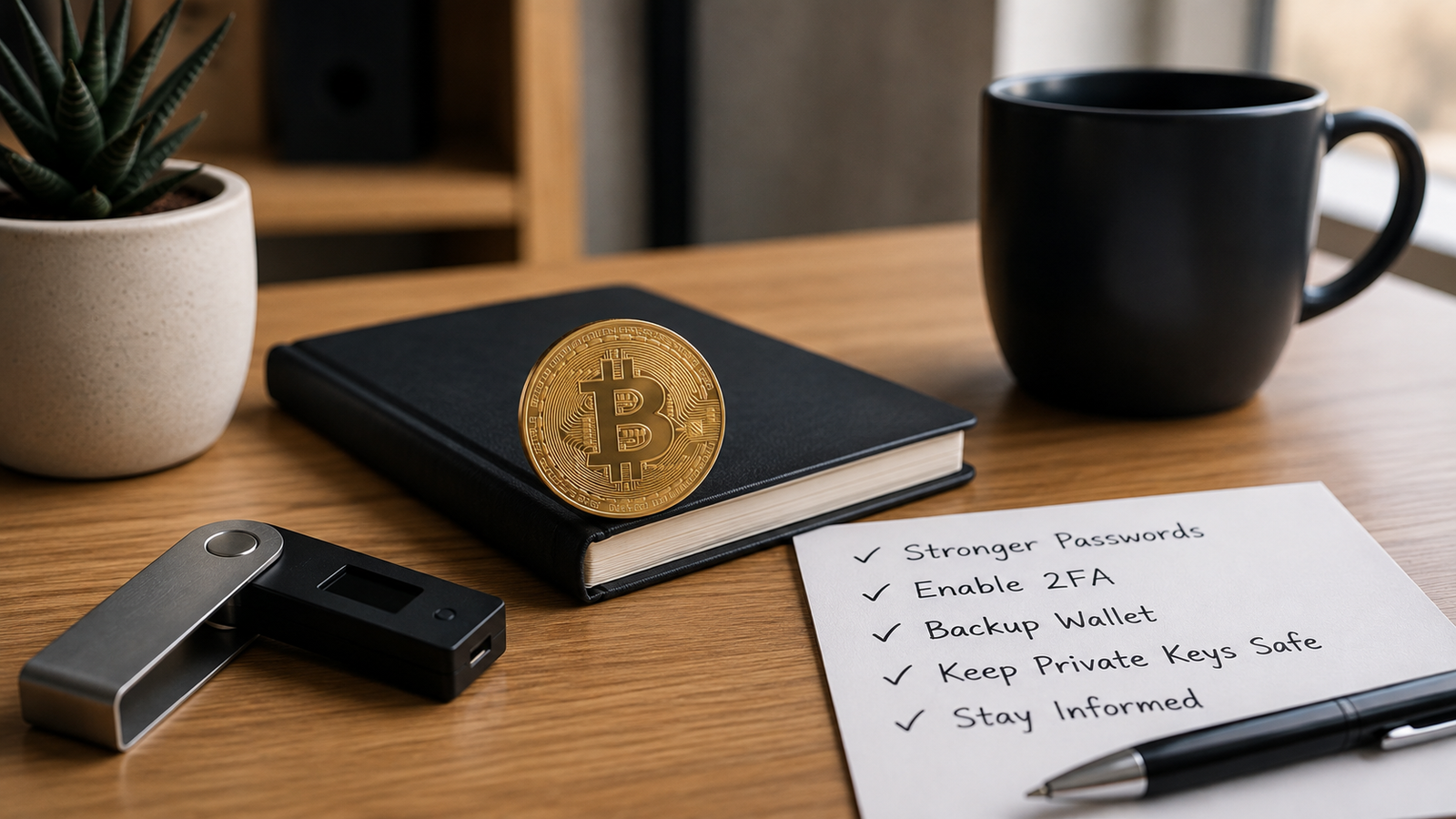
Rather than memorizing a long list of recommendations, new users should build a short security checklist that prioritizes the most important measures.
Good security hygiene starts with choosing a strong password and enabling two-factor authentication wherever possible. In addition, one should ensure that their devices are up to date and avoid installing software from untrusted sources. Another essential item is designating a secure place to store critical recovery information, which may involve some research depending on the wallet being used. The point is to avoid leaving sensitive data on unsecured websites or apps.
Checklist items are meant to become second nature, so that security remains consistent even when one is in a hurry.
Understand Who Has Control Over Keys
When it comes to interacting with the blockchain, there is a crucial difference between having an account with someone else and being in control of one’s own wallet. The former involves trusting a custodial service to hold one’s Bitcoin, while the latter entails taking full responsibility for securing self-custody keys.
Each option comes with its own risks, so one should research what steps are necessary in either case.
For instance, if someone leaves their recovery phrase unsecured or loses a device storing recovery information, funds will be permanently inaccessible. On the other hand, a custodial wallet may be at the mercy of the service’s ability to protect against hacking attempts and internal theft.
The point is to understand the responsibilities one undertakes rather than simply choosing between custodial and self-custodial options.
Treat Recovery Phrase Like Private Keys
As mentioned above, recovery phrases can be used to regain access to self-custody wallets. This means that one should treat them with the same level of care as private keys.
First and foremost, one should never share a recovery phrase with anyone, including individuals one believes to be trustworthy. One particularly common scam involves fake customer support asking users to provide their recovery phrases under the pretext of assisting them.
If someone needs help with their wallet, one should use official support channels found on the wallet’s website. In most cases, an interaction should never involve giving out recovery phrases or paying someone to provide support.
One should always double-check such messages if a customer support representative says it is necessary to share sensitive information in order to recover lost funds.
Make Transaction Checking a Priority
A Bitcoin transaction should never be treated like any other kind of digital transaction. One should always double check the receiver’s address and amount before sending funds, particularly if one is using a new wallet or exchange.
In addition, one should spend more time verifying larger payments or payments being sent to an unknown address. In some cases, a smaller test transaction might be appropriate when one is using a new wallet, especially if extra fees are involved. However, the point is to make checking a habit, rather than relying on exceptions.
Once again, the best way to avoid problems is to slow down and make routine checks before confirming any transaction.
Avoid Anyone Trying to Sell “Guaranteed Profits”
Bitcoin’s price changes constantly and is subject to market forces one cannot control. Therefore, one should always be wary of anyone claiming to know what will happen next – especially when it comes to promises of “guaranteed profits.”
It is normal for people to disagree about what Bitcoin will do, but one should always be skeptical of anyone presenting themselves as somebody who has reliable knowledge about yields. One should always decide what to do based on their own risk tolerance and research, rather than what one hears from social media personalities.
One should be extra cautious when one is being pressured to make a transaction or send more money to someone. In any case, guaranteed profits are always suspicious, so one should investigate anyone acting this way.
Remember: Confidence is not always an indicator of being right. One should be particularly wary of anyone using forceful language to promote their services.
Don’t Confuse Convenience With Safety
The easiest setup is rarely the safest one, but the most secure option is not necessarily the most convenient one.
Some beginners may opt to use a particular custodial wallet because it is convenient to use. In contrast, others may want to pursue self-custody, without fully realizing the dangers associated with it. The point is to keep expectations realistic.
One should recognize the trade-offs that come with convenience and security. For example, one might have to deal with a less intuitive interface in order to benefit from greater security. Other factors to consider include:
- Ease of account recovery
- Direct access to keys
- Ability to make frequent transactions
- Opportunities to store large amounts of Bitcoin
- Simplicity of using an exchangeExtra security measures
Once one understands one’s priorities, it will be easier to select options based on real-world needs, rather than theoretical advantages.
Keep Everything Updated
Keeping accounts secured is an ongoing process. For instance, one should always make sure that contact information and account details match those associated with one’s Bitcoin accounts. As a general rule, one should update one’s information on any service every time one switches devices or email addresses. Likewise, one should remember to update one’s wallet information when one is away from one’s computer or phone for an extended period of time.
In any case, it is better to stay prepared so that one can avoid problems during emergencies.
Build a Routine Before Increasing Exposure
New users often ask about how much Bitcoin they should buy before learning how to participate in the ecosystem safely. As a rule of thumb, it is best to adopt a different approach: building a safer routine before buying more Bitcoin.
In other words, one should learn the fundamentals and develop habits before buying any Bitcoin. Then, one should practice good security hygiene and develop a set of routines regarding transactions and checking wallets. Finally, one should learn about scams and other threats in order to spot potential problems.
Once one has done this, one can decide for oneself whether Bitcoin is something worth investing in – based on one’s personal circumstances.
The amount of Bitcoin one holds is not as important as developing safer habits over time.
Plan Ahead for Various Emergencies
Many people fail to consider what one should do if one’s phone is stolen, one’s computer is damaged, or one is locked out of an exchange account and one’s wallet at the same time. One has to be prepared to handle various emergencies in order to avoid making impulsive decisions.
One should ask oneself questions like these:
What should I do if my phone is stolen?
What should I do if my computer breaks down?
What should I do if I’m locked out of an exchange or wallet?
How should I react to suspicious messages?
For self-custody users, it is particularly important to know how one’s wallet handles emergencies. One should make sure to remember one’s recovery phrase and understand the process of importing it, just in case one loses a device storing that information. Meanwhile, custodial users should learn about their account recovery options in advance.
In any case, one should never make assumptions about one’s own safety in the hopes of avoiding problems. Instead, one should plan ahead for emergencies and avoid making rash decisions once they occur.
Final Thoughts
Safer participation in the Bitcoin ecosystem is often about making better choices and developing good habits, rather than relying on a few tricks. In the guide above, we discuss some important routines for new users:
Keeping learning and investing separate
Enabling multi-factor authentication
Double-checking addresses when making transactions
Avoiding anyone trying to sell “guaranteed profits”
Understanding who has access to one’s keys
Following good security hygiene and update schedules
Planning ahead in order to avoid emergencies
Bitcoin will continue to evolve and attract new users, companies, and ideas. In turn, newer participants will always need guidance about what to do and what to avoid.


