





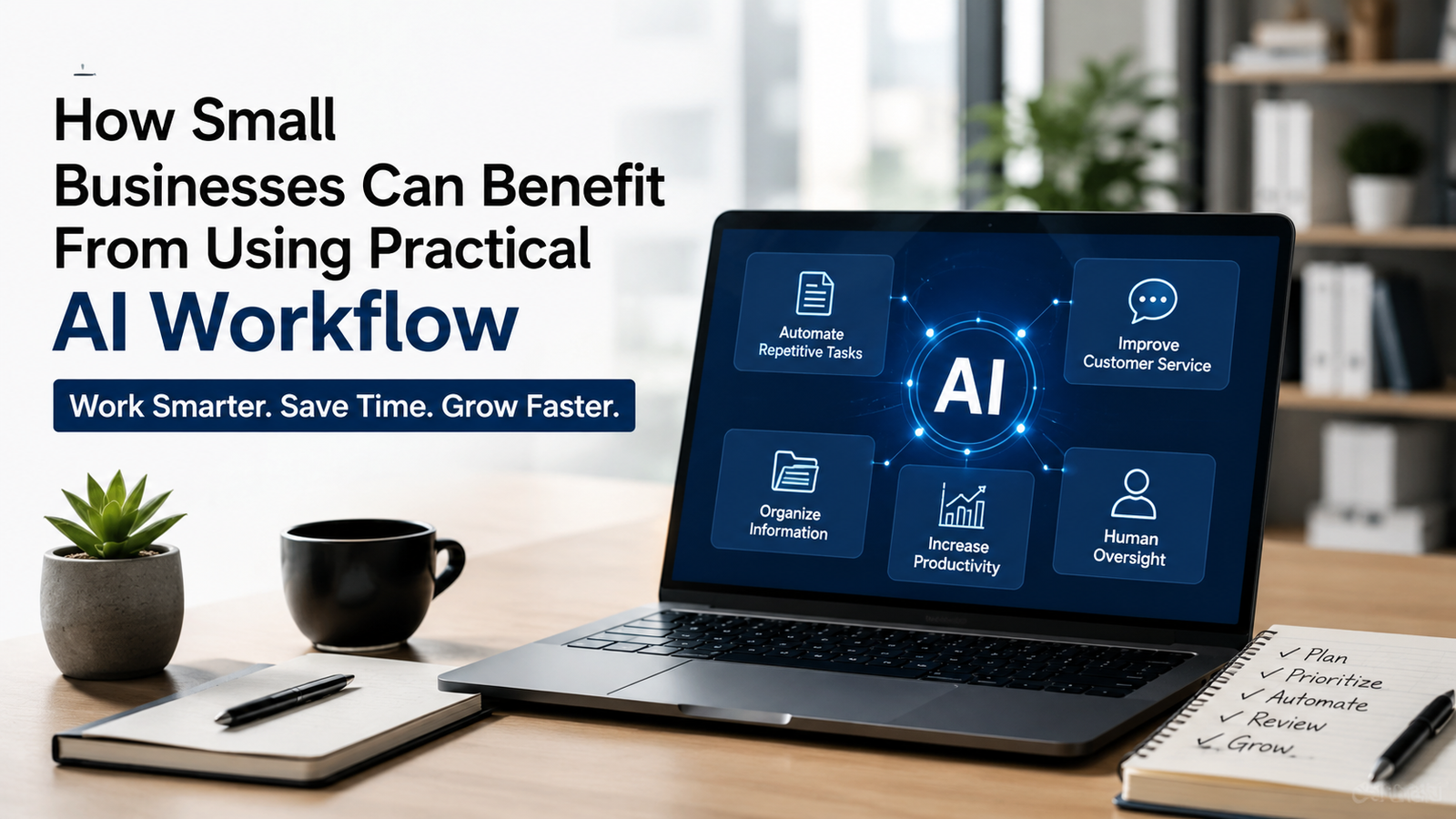
Artificial intelligence can help businesses write, communicate with customers, research, organize information, and complete other routine tasks.
However, there is one pitfall that many organizations fall into when adopting artificial intelligence – and it is an easy trap to fall into.
The issue is that having access to more technology does not always mean that a business is more productive.
It is possible to sign up for multiple artificial intelligence subscriptions, build sophisticated automation, and waste more time than you would without the technology.
To avoid falling into this trap, small businesses should consider implementing a practical AI-powered process that makes people more productive.
Instead of asking the question, “what AI tools should we buy,” organizations should instead ask the question, “what tasks do we spend too much time doing, and how can artificial intelligence make us more productive?”
How to Start Using Practical AI at Your Small Business
The easiest way to implement artificial intelligence incorrectly is to begin the process by focusing on the technology.
Before buying any AI-powered tools, it is necessary to determine what tasks you want the technology to complete.
Look at the daily responsibilities of your employees and determine what tasks can be automated.
What tasks are repetitive?
What takes too much time?
What tasks involve organizing information?
What tasks involve writing similar content over and over?
These are all valuable questions that can help you identify the work you want to automate.
For instance, a company may want to automate the process of summarizing meeting notes, while another company may want to organize customer questions into categories.
These are more practical starting points than attempting to implement artificial intelligence simply because it is available.
How to Determine Which Activities to Automate With AI
Not every task is right for automation, and you should begin your process with simple, repetitive tasks that people normally perform.
Creating a first draft, summarizing information, and organizing similar questions are all ideal candidates for automation.
On the other hand, any process that involves making difficult ethical, legal, or moral decisions may be inappropriate for automation.
The point is not to use artificial intelligence to remove all human judgment from a process; it is necessary to reserve judgment for humans and only allow AI to complete the routine aspects of a task.
Using AI Tools to Create First Drafts
One of the easiest ways for a small business to implement artificial intelligence is to use it to generate first drafts of documents.
An employee in the marketing department could use an AI tool to create an initial draft for an article, while a sales professional could use the technology to organize meeting notes into a first draft for an email, and a manager could use the technology to generate an initial list of action items from a series of meeting notes.
However, these first drafts should never be published as is; every employee should review the document for accuracy, additional information, tone, and overall appropriateness, especially if the document will appear in front of customers or clients.
AI tools are useful for creating the first drafts of documents, but people should always review the work before releasing it to the public.
How to Create an Internal Knowledge Base to Help People Find Answers
Companies tend to create knowledge bases that contain information about their own products and services, but few organizations use these resources to their full potential.
Instead, companies should use their knowledge base to organize the most commonly asked questions, internal procedures, and other relevant information, and then use artificial intelligence to help people find this information.
Similarly, the right AI-powered tools could help summarize relevant information from the knowledge base.
The value of this technology depends on the accuracy of the information stored in the knowledge base, which means that organizations need to ensure that their information is regularly updated.
How to Automate the Predictable Part of a Task, Not the Entire Task
Many companies make the mistake of attempting to automate an entire process with artificial intelligence, but the appropriate goal is to only automate the predictable part of a task.
For instance, AI technology could be used to identify the main ideas from a customer email and organize the information into categories so that an employee can quickly see what the customer is asking for.
The same principles could be applied to reports or other types of documents.
The AI tool would organize and summarize the information, while a human would interpret the information and make judgments about the task.
This allows organizations to benefit from the speed of automation while still retaining human judgment throughout the process.
How to Improve Your Customer Service Without Alienating Customers
Artificial intelligence can be used to help organizations improve their customer service, so long as businesses do not remove human judgment from the process.
For instance, an AI assistant could be programmed to answer some of the most common questions about a company’s hours, products, or policies, but it is unwise to use the same technology to deal with complex or sensitive issues.
If a customer has an issue that requires extensive troubleshooting, a human should always handle the request.
Similarly, a customer with complex or unique concerns should always speak with a customer service representative directly.
The best customer service strategy typically involves using artificial intelligence to handle simple requests while leaving more complex issues to humans.
How to Use AI Tools to Help You Organize Customer Feedback
Many organizations fail to recognize the value of customer feedback, but it is always possible to leverage this information to improve your business by using artificial intelligence to organize and summarize customer feedback, and then acting on this information.
For instance, a business may receive customer feedback in the form of emails, reviews, social media posts, surveys, and other communication methods.
Artificial intelligence could be used to summarize these messages and organize them intocategories.
For instance, there may be several customers who consistently complain about the same issue, such as the complexity of the instructions provided with a product or a problem with the shipping and delivery process.
This information could then help the organization determine which issues to address first.
While the technology should never make judgments about what to do with this information, it can help summarize and organize this information so that humans can determine the best course of action.
How to Protect Your Confidential Information
When a business begins using artificial intelligence, it is crucial to remember that technology always comes with risks.
Before allowing employees to enter customer data, confidential information, or other sensitive information into an AI tool, it is necessary to understand how the technology handles this information.
Additionally, employees should have an internal policy that ensures they only provide approved information to an outside organization.
Anyone working with an external AI provider should understand what information is appropriate to share with the technology.
A simple internal memo about which information is public, internal, and confidential can help a company avoid serious mistakes.
It is much easier to train employees to be careful when using new technology than it is to recover from a data breach.
How to Measure Your AI Workflow’s Productivity
Any company that wishes to use artificial intelligence to complete routine tasks should always be aware of the value of these tools.
A business owner or manager should measure how helpful the technology is based on how much time, effort, and energy it saves.
If an employee spends one hour creating a weekly report and another thirty minutes correcting the mistakes made by artificial intelligence, the organization has not benefited from the technology.
By measuring how much time and effort you spend on a task before and after you automate it, you can determine whether you are truly benefiting from the technology.
You should also consider the value of human judgment, the quality of the work, and how often employees use the technology.
If these factors are positive, then it is wise to continue using the technology to automate routine processes.
How to Train Your Employees to Help You Use AI Technologies
Even the best artificial intelligence systems are ineffective if employees do not know how to use them.
Anyone using an AI tool should understand the benefits and limitations of the technology and always be aware of when the technology provides incorrect or inappropriate information.
A short internal memo can help employees understand how to interact with the technology.
For instance, they may need to know good prompts to use with the technology, information they should never enter into the system, and how to evaluate the suggestions made by the system.
The goal of this information should not be to teach employees to think like computer scientists; it should be to help these individuals understand how to use the technology in their daily jobs.
Three Simple AI Projects That Small Businesses Can Try
If a small business wants to make the most of its first AI project, it should consider implementing a few simple changes, such as having the technology summarize meetings and organize customer inquiries.
It may also be possible to repurpose content by taking a single article and generating multiple variations of the same information in different formats. These projects are valuable because they are relatively simple to implement without wasting too much time or money on complicated processes.
Key Takeaways for Small Businesses Looking to Use Practical AI
Small businesses do not need to make artificial intelligence the center of their operations – in most cases, the best option is to use a practical AI tool to improve one simple process that previously took too much time.
To maximize your chances of success, always keep people involved in the process, protect confidential information, double-check any information created by AI systems, and measure how much time and effort you spend on these tasks.
Once you have optimized a simple process, you can begin looking for additional opportunities to implement artificial intelligence.


