





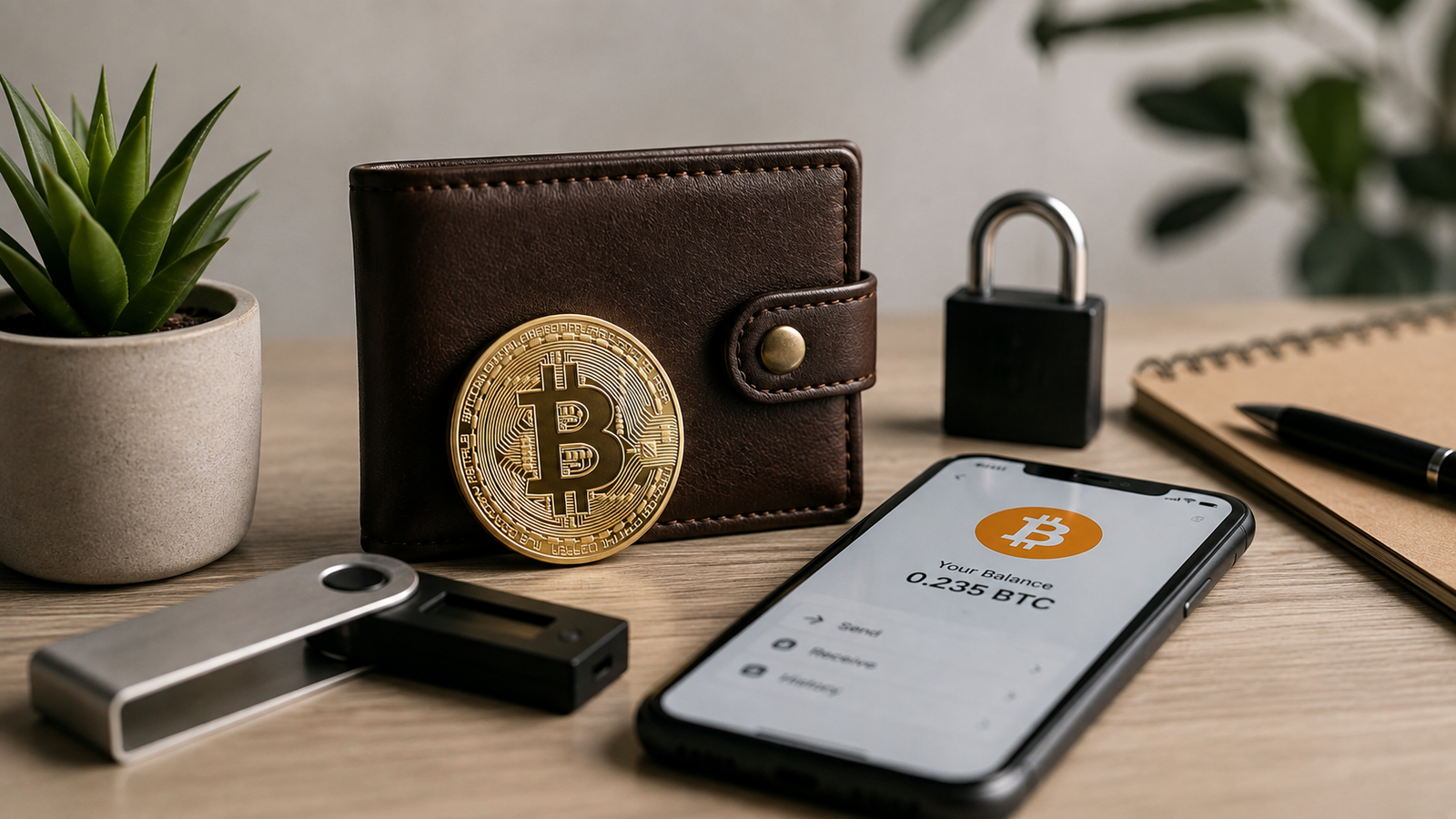
For someone new to the concept, the word ‘wallet’ in relation to Bitcoin can be misleading. You might reasonably expect a Bitcoin wallet to function in a similar way to a regular leather wallet: a convenient place to store cash and cards. However, it is not quite that simple.
While a regular wallet contains your money and payment cards, a Bitcoin wallet merely stores the cryptographic keys required to access funds. This is an important difference: Bitcoin, itself, is stored elsewhere, in a distributed manner, inside a technology called the blockchain.
This means that selecting a Bitcoin wallet is not just a matter of choosing a pretty application icon and convenient interface. You must understand how the wallet you have selected interacts with (or safeguards) the cryptographic keys and what happens to your Bitcoin if anything were to happen to your phone – or your ability to access it.
Getting Started with Understanding a Bitcoin Wallet
When you open a Bitcoin wallet on your phone, you are presented with a couple of options. You can either receive Bitcoin into it and view the contents or, if supported by the application, you can use it to generate and store the cryptographic keys necessary to make payments and receive funds.
However, one thing all wallets have in common is the private key. This is a cryptographic piece of information and, if someone gets access to your private key, they will be able to spend your Bitcoin. That is why it is essential to understand that a wallet is not a vault.
Bitcoin is not stored within an application in your phone. Rather, it is stored across thousands of computers owned by different people and organisations in a technology called the blockchain. A Bitcoin wallet merely facilitates interaction with the blockchain.
Once you understand this, the concept of a Bitcoin wallet becomes much easier to grasp.
Custodial and Self-Custody Wallets Explained
One of the first choices you have to make as a beginner concerns whether you want a custodial or self-custody wallet. In short, this is a choice between trusting a company to hold and manage your Bitcoin for you or managing it yourself.
A custodial wallet, such as one provided by a cryptocurrency exchange, holds your private keys for you, making it much easier to use – much like a traditional bank. On the other hand, a self-custody wallet gives you full control over your funds but requires more responsibility on your part.
If you lose access to a self-custody wallet with no backup, there is no customer support centre ready to assist you. There is no ‘recovery’ procedure. Your funds are inaccessible and, in all likelihood, lost forever.
It is important to note that neither of these two options is wrong or right – it comes down to personal preference and situational factors. Nevertheless, you need to fully understand the implications of either choice before committing to it and transferring any amount of Bitcoin.
Hot Wallets, Cold Storage and Other Security Considerations
You may also hear Bitcoin wallets classified as either hot or cold. A hot wallet is connected to the internet in some capacity, while a cold one is not. Once again, it is all about trade-offs between convenience and security.
The most common hot wallet is a regular software wallet on your mobile phone or computer. On the other hand, there are also hardware wallets specifically designed for the purpose of keeping your Bitcoin offline and away from would-be attackers.
It is important to understand that having a wallet connected to the internet at all times makes it more vulnerable to malicious attacks. If you are the type of person who makes frequent small transactions, this is a risk worth taking. On the other hand, if you hold large sums of Bitcoin for long periods, you are much better off keeping it in cold storage.
As a beginner, you do not need to go all out and secure your stash in a vault beneath the Swiss Alps. First, understand what the differences between hot and cold wallets are and how each one works. Then, you can determine which one suits you better based on your priorities.
Protecting Your Recovery Phrase
If you go for a self-custody wallet, you will most likely be introduced to the concept of a recovery phrase. The recovery phrase is, more or less, the master key to your wallet: depending on the particular implementation, it can be used to recover your wallet on another device if you lose access to the one you are using.
It goes without saying that this knowledge must be treated as sacred: under no circumstances should you share it with anyone or input it into a website under the pretence that it is ‘verifying’ your access to the wallet.
Scammers can easily mimic legitimate wallet interfaces and convince you to enter your recovery phrase on their fraudulent website. In all honesty, no legitimate service should ask for your recovery phrase – if they do, that is already suspicious behaviour.
As a rule of thumb, apply Occam’s Razor to any request for your recovery phrase – and always double-check the website URL before inputting it into the wallet recovery interface.
Finding the Right Bitcoin Wallet for You
It bears repeating that there is no single wallet better than the rest. Rather, you must assess your own requirements and decide which cryptocurrency wallet aligns with your personal preferences and priorities. The questions you should ask yourself include:
Does this wallet support Bitcoin?
Does the wallet provide sufficient protection over my private keys?
What happens to my keys if something happens to my phone?
Is the wallet software secure?
Can I easily receive and send Bitcoin?
How easy is it to confirm that I am using the official wallet software?
Asking these questions will allow you to whittle down the overwhelming number of options presented to you. Remember: an intuitive, beginner-friendly interface is not always the best choice.
If you are just getting started with learning about Bitcoin, simplicity and transparency are much more important than bells and whistles you barely understand.
Avoid Sending Bitcoin in a Hurry
When you are sending Bitcoin, always double-check the address you are sending it to and the amount you are sending. It is not uncommon for people to send significantly more Bitcoin than intended and, once executed, such a transaction cannot be cancelled or reversed.
Therefore, it is always advisable to do a small test transaction with a tiny amount of Bitcoin before attempting to send a large sum. It is also important to understand how much fees for a given transaction will cost you: do not assume that a wallet will always charge exactly the same amount per transaction.
The extra minute it will take you to research the fee should be perfectly worth avoiding the disaster of losing your hard-earned Bitcoin in a single transaction.
Watch Out for Phishing Scams and Fake Crypto Websites
Unfortunately, the world of cryptocurrency is full of scammers. One particularly prevalent scam involves creating fake websites practically indistinguishable from the real wallet or crypto exchange of your choosing. The goal of the scam is to get you to enter your private keys on a fraudulent website, thereby allowing the scammer to steal your Bitcoin.
This is why it is of paramount importance to only use trusted websites for interacting with your wallet. If a site asks you to enter your keys for verification purposes, they are most likely fake. If you have downloaded wallet software from a random website, there is a good chance it is infected with malware.
A rule of thumb is to always interact with your cryptocurrency wallet via known and trusted websites or applications. Moreover, be wary of phishing attempts, such as random tweets informing you that you need to ‘verify’ your cryptocurrency wallet. Scammers use such tweets to entice victims into visiting fake websites and entering their private keys, thus exposing themselves to theft.
Do Not Store Your Private Keys in a Convenient Place
Speaking of private keys, it is important to talk about the ‘easy’ way of storing them. Some people like storing their encryption keys in standard text files or even email accounts. Unfortunately, this can leave you particularly vulnerable in the event of an unauthorised breach of your email or computer.
The safest way to store keys is, again, completely individual and dependent on the wallet you are using. However, the general rule is to treat your private key as you would a physical document with all your personal information on it. Store it securely and with care: do not share it or leave it in a potentially unsafe place. You do not want to learn about the importance of a private key encryption after losing all your Bitcoin because you left it in an unprotected location! Before using a self-custody wallet, it is important to understand how your private keys are to be stored and what the backup procedures are. Once again, not knowing is not an excuse if you get scammed.
Getting Started with a Little Bit of Bitcoin Goes a Long Way
As a beginner, you do not have to get a substantial amount of Bitcoin straight away. You can begin your journey by merely learning about the various technologies and features that make up the wallet: addresses, private keys, recovery phrases, fees and so on. You can familiarise yourself with the general functioning of a wallet before you begin interacting with it in earnest.
In addition, you can first learn about exchanges before deciding to use one. This way, you will feel much more confident about making financial commitments within the wallet ecosystem.
Ultimately, Bitcoin can be fascinating to learn about, but you must get to know it before you grow fond of it and then become obsessed with it.
Final Thoughts
A Bitcoin wallet is not just a convenient place to store your cryptocurrency: it is the enabler of interaction with the technology. Therefore, it is important to understand how a particular wallet operates and safeguards your funds before using it. Make sure to understand the basic principles behind the technology before engaging with the wallet beyond checking your balance.
If you are unsure about how to protect your funds, always err on the side of caution and utilise the built-in security features of the application. It is easy to think that a flashy wallet with an intuitive interface is perfectly secure, but it pays to research the underlying security features before trusting large sums of money to it.
Never share your private keys with anyone and always double-check transaction details before confirming a transfer of Bitcoin. Remember: once sent, a transaction cannot be cancelled or reversed. Finally, avoid fake phishing websites by only utilising trusted resources for interacting with your cryptocurrency wallet.


